
Bengaluru, Before and After the Rush
One day in the city, from the quiet chai hour to the late-night calm, and the tech professionals, drivers, nurses, riders and workers who keep it moving.

Mohit Malaya Nandy
Software Engineer & Product Builder
On this page
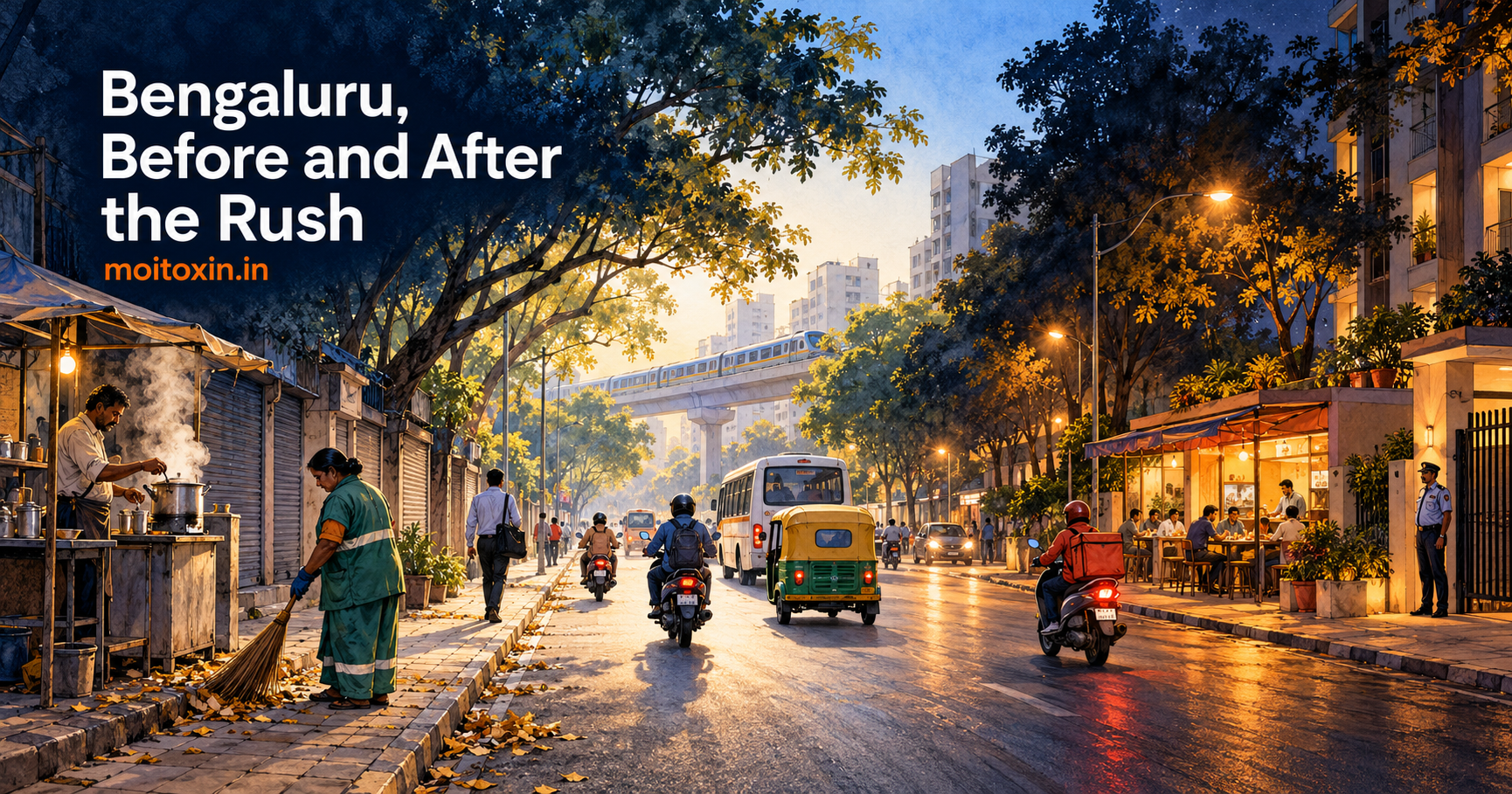
Before Bengaluru becomes a conversation about traffic, deadlines, and how long it takes to get anywhere, there is a quieter hour.
Shop shutters are still down. The air carries a little coolness. A few vehicles pass through streets that will soon demand everyone’s patience. Somewhere, a kettle is already on the stove.
The city is awake. It simply hasn’t started hurrying yet.
This is a story about one day in that city: the quiet before the rush, the rush itself, and the long, softer hours after it. It is also about the people who carry the day, from the engineer on an early call to the woman sweeping the road before anyone else is up.
A morning that begins with chai#
At a small roadside stall, the day starts with familiar movements: water heating, tea brewing, glasses finding their place on the counter.
Steam rises from a pot and disappears into the morning air. The vendor moves between the stove and the counter while someone waits with a phone in one hand. Another customer watches the road.
There is no elaborate setting. A narrow counter, a few containers, somewhere to stand. But for the time it takes to drink a glass of chai, it feels like enough.
The first sip asks you to slow down. It is too hot to rush.
Around you, the morning continues. A delivery rider stops briefly. Someone picks up tea for a colleague. A short conversation begins and ends before you catch the subject.
These small exchanges give the street its rhythm.
The people who wake the city#
The quiet hour is only quiet for some of us. For many people, it is already the middle of their working day.
The pourakarmikas are out before sunrise, sweeping leaves and yesterday’s litter into neat piles along the kerb. Most people will walk on a clean road today without ever seeing who cleaned it.
A milk van stops at the corner, and packets change hands in a practised rhythm. Newspapers land on doorsteps. Flower sellers set out jasmine and marigold beside the temple gate, the colours brighter than anything else on the street.
At the gate of an apartment complex, a security guard finishes a twelve-hour night shift. He has watched the building sleep. He signs the register, hands over to the morning guard, and starts the long ride home just as everyone else is waking.
At a hospital nearby, nurses change shifts. One group walks out tired, another walks in with their hair still wet. Patients notice only that someone is always there.
The auto drivers line up near the bus stop, one reading the news on his phone, another wiping down his seat with a cloth. The first fare of the day matters. It sets the tone.
The city before your screen#
It is easy to experience Bengaluru through a phone.
A map tells you how long the journey will take. A notification decides what needs attention. A calendar divides the day before you have properly entered it.
Walking early offers a chance to look beyond those instructions.
There is a tree whose branches stretch farther across the road than you noticed yesterday. A faded wall catches the sunlight. Someone sweeps the pavement outside a shop, gathering yesterday’s dust before opening for today.
None of these moments asks to be photographed. You can simply notice them.
For anyone who spends much of the day building, writing, designing, or working through a screen, that can feel surprisingly difficult. The instinct is to capture something, share it, or turn it into an idea.
Sometimes it is enough to keep walking.
Following the light#
As the sun rises, light begins to reach between buildings and through the roadside trees.
One side of the street brightens while the other stays in shadow. Leaves move overhead. A pedestrian steps around a patch of uneven pavement without breaking the rhythm of their walk.
There is something reassuring about these ordinary movements.
Most stories about a city concentrate on its landmarks, its busiest neighborhoods, or the places everyone says you should visit. Yet a city also becomes familiar through repetition: the same corner, the same stall, the same stretch of road at a different hour.
A morning walk gives those familiar places a little room to surprise you.
The rush arrives#
The quiet does not last.
More shutters rise. Vehicles begin to gather at junctions. Conversations overlap with engines and horns. The tea stall gets busier, and the pauses between customers become shorter.
By eight, the city has changed its mind about the day. School buses weave through lanes that were empty an hour ago. Parents stand at gates with water bottles and last-minute reminders. On the main roads, two-wheelers fill every gap that opens, and every gap closes again.
At the metro station, people move at two speeds: those who know exactly which door will stop in front of the stairs, and those still learning. Earphones go in. Laptop bags are pulled to the front. Nobody talks much, and nobody needs to.
Office cabs and company shuttles head toward the tech corridors: Outer Ring Road, Whitefield, Electronic City, Manyata. Inside, someone is already on a call, voice lowered, nodding at a screen. Someone else is asleep against the window, making up for a meeting that ran past midnight.
Somewhere on the way, every commuter learns the same lesson. In Bengaluru, distance is measured in minutes, not kilometres, and the number of minutes depends entirely on the hour.
A day in tech#
For a large part of the city, the workday begins in a glass building with a badge at the door and coffee on every floor.
The morning stand-up is short in theory. Each person shares what they did yesterday, what they will do today, and what is blocking them. The real work happens after: reading through a pull request, chasing a bug that only appears in production, sitting with a designer to decide whether a button should move six pixels or not at all.
Time zones shape the day. Some teams start early to overlap with Europe. Others save their energy for the evening, when colleagues in the United States come online. It is common to see someone leave the office at six and open their laptop again at nine, this time at the dining table.
Lunch is a negotiation between the canteen, a food delivery app, and the darshini across the road. The 4 p.m. filter coffee is close to a ritual. Ideas are exchanged in queues and corridors as often as in meeting rooms.
Not all of tech lives in the big campuses. In Koramangala, HSR Layout and Indiranagar, small teams work out of shared spaces and cafés, building products that might not exist next year, or might change how millions of people pay, travel or learn. A founder pitches to an investor over cold coffee. A developer ships a fix from a corner table and quietly celebrates with a second croissant.
The work is rewarding, and it can be relentless. There are release nights, on-call weekends, and the particular tiredness of having spent eight hours in calls. Ask people in tech what they miss, and many give the same answer: daylight, and time that does not belong to a calendar.
A city of engineers still runs on people whose work never appears on a screen.
Everyone else who keeps it moving#
The tech parks get the headlines, but the city depends on many other kinds of work, much of it done in plain sight and rarely noticed.
Teachers stand in front of classrooms of forty children and try to reach every one of them. Doctors and nurses move between wards that never close. Bank staff, government clerks and shopkeepers keep the ordinary business of life running: accounts opened, certificates signed, rice weighed, change counted.
On construction sites at the edge of the city, workers who came from other states raise the apartment towers and office blocks that will soon house someone else’s life. Their day starts early to avoid the worst of the afternoon heat.
Delivery riders cross the city dozens of times, guided by an app and a timer. They know the shortcuts, the potholes and the apartment gates that never open on the first ring better than anyone. Their busiest hours are everyone else’s mealtimes.
Domestic workers travel between three or four homes before noon. They cook, clean and care for children and elderly parents, making it possible for many of the city’s professionals to leave for work at all.
Auto and cab drivers carry the city’s conversations. They hear about promotions, interviews and breakups. They know which roads flood in the rain and which junctions are best avoided at six. Many of them could tell you more about how Bengaluru actually works than any map.
Every one of these jobs fits into the others. The engineer’s day depends on the cook, the driver, the guard and the cleaner. The city is less a collection of separate lives than one long chain of people making each other’s days possible.
After the rush#
In the evening, the rush returns in the opposite direction, slower and more tired. Brake lights stretch down the flyovers. In the metro, people lean against the doors and scroll without reading.
Then, gradually, the city exhales.
Darshinis fill with people eating standing up: idli, vada, a plate of rice bath, another coffee. Parks see a second wave of walkers. Badminton courts and gyms come alive with people trying to give their bodies back the hours their desks took.
Neighbourhood markets glow under bare bulbs. Vegetable vendors call out prices that drop a little as the night goes on. Families walk together after dinner, children running ahead. Somewhere a temple bell rings, and somewhere a live band starts its first song in a pub.
For some, the workday is not over. A support team begins its night shift, ready to answer customers waking up on another continent. A developer joins a call with colleagues in California, the city’s quiet a strange backdrop to someone else’s morning. Delivery riders are busiest now, threading between late dinners and last orders.
By eleven, the roads that were impossible at six are almost empty. A few autos wait at the corner. The last metro carries a scattering of passengers, each lost in their own end of the day. The security guard is back at the gate, beginning another night.
The quiet returns#
Late at night, Bengaluru sounds a little like it did in the morning. A dog barks once and stops. A scooter passes and fades. The trees move in a breeze that finally feels cool.
The day has been long for almost everyone. It was long for the engineer who shipped a release, for the nurse who stayed past her shift, for the rider who lost count of his deliveries, for the teacher grading notebooks at the kitchen table.
They will mostly never meet. But they shared the same roads, the same rain clouds, the same hour of quiet before it all began.
Bengaluru will keep moving.
For a few minutes before joining it, you had time to look around.
And tomorrow morning, the kettle will be on again.
Finding the quiet hours#
None of this needs a plan, but a few small choices make the city’s quieter hours easier to find:
- Go out between roughly 6 and 7:30 a.m., before most shutters rise and the junctions fill.
- Pick one stretch of road near home and return to it. Repetition is what lets a place surprise you.
- Stop at the nearest chai stall, not the best-known one. Stand for the whole glass.
- Take a late evening walk after the traffic thins, when the city slows down a second time.
- Learn the names of the people you see every day: the guard, the vendor, the driver at the corner.
- Leave the phone in your pocket until you turn for home.
Found this useful? You can support my writing on GitHub Sponsors or with a coffee.